
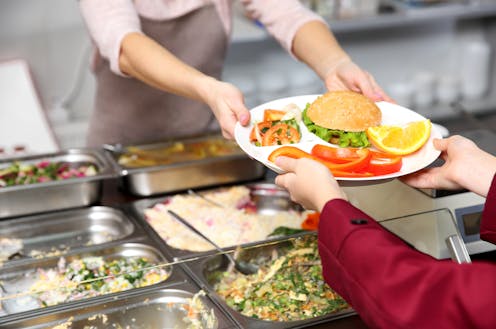
Faculty meals applications may also serve youngsters’s essential social and emotional wants. (Shutterstock)
“Now you simply should starve,” a pupil informed us bluntly after we requested about their new college lunch program.
The varsity had not too long ago transitioned from an in-house program, with meals ready and served by lunch employees, to an externally catered program the place lunches have been ordered on-line and dropped off. With the lack of acquainted lunch employees, youngsters not knew who to show to once they bought the flawed lunch order, didn’t have lunch in any respect or their sandwich from residence was mouldy.
These children taught us an vital lesson: college meals applications work higher once they actively nurture care and connection.
We research the impacts of college meals applications on the well-being of youngsters and households in British Columbia. In 2019, we documented lunchtime in three completely different faculties to be taught what mattered to college students as they transitioned to a brand new mannequin of college lunch.
As we have been writing our report of the research’s findings, what struck us most was how usually college students talked about meals as a supply of care.
Children talked about care
At its most simple, care is any exercise executed to help and promote life, argues College of Minnesota political scientist Joan Tronto who examines the function of care in democratic societies. By this definition, feeding youngsters is a vital side of caring for them.
But surprisingly, care is commonly ignored in public conversations about college meals. Faculty meals advocates usually concentrate on the potential of colleges to offer nutritious meals and alleviate starvation. However the caring labour of connecting children with meals is absent on this argument.
In distinction, in our analysis, we discovered care was a relentless chorus in youngsters’s discuss lunch. College students informed us how a lot it meant when mother and father packed meals they loved, when classmates appeared out for one another and shared meals, and when the previous lunch staff paid consideration to what they appreciated and saved a watchful eye out for college students. These acts of care are seemingly much more vital now, amidst the stressors of going to highschool within the pandemic and as youngsters modify to life in school after months of lockdown.
Our analysis signifies that when college meals applications worth and facilitate human connection, they may also help enhance youngsters’s entry to wholesome meals and nurture their sense of safety and well-being.
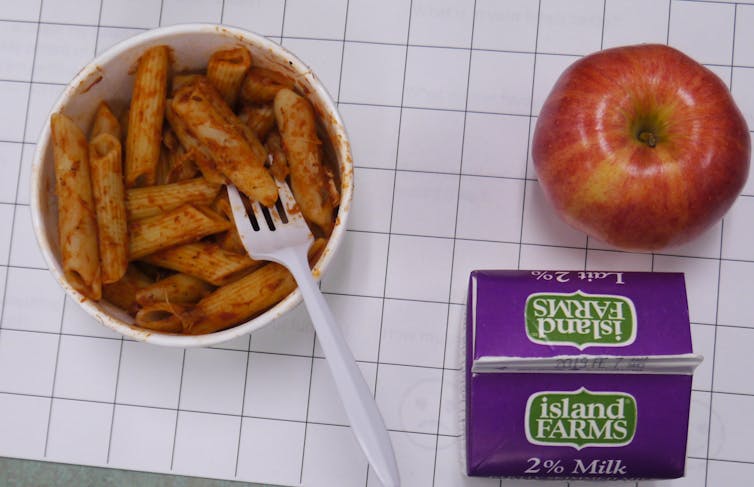
A typical meal from the previous college meals program ready by in-house lunch employees.
(Sinikka Elliott), Creator supplied
Relationships behind the meals
College students profit once they know that trusted adults are searching for his or her meals wants. Lunch staff within the faculties we studied related with college students in different methods, too. Cheery personalised notes handwritten on paper lunch baggage by former lunch employees put a smile on college students’ faces. Many college students talked concerning the care and thoughtfulness of the employees in figuring out them and their meals preferences.
College students valued the caring work of college lunch a lot that it formed their concepts of the meals itself. To our shock, after we visited faculties throughout lunchtime and requested college students what they thought concerning the catered and in-house applications, some college students had very completely different impressions of the meals from the 2 applications — impressions that didn’t actually align with the precise meals.
“It’s airplane meals,” one pupil stated, referring to the catered meals. “It’s much less do-it-yourself,” stated one other.
“Selfmade” usually means made out of scratch utilizing contemporary elements. In truth, the brand new catered program concerned extra scratch cooking and fewer prepackaged meals than the previous program.
But college students responded to not what was on the menu, however to the relationships behind the meals. The lunch employee who used to make their brown-bag lunches was broadly recognized and appreciated by college students. The that means of the meals modified for them once they didn’t view it as a part of the varsity’s caring net of help. Now it got here from an nameless, for-profit catering firm.
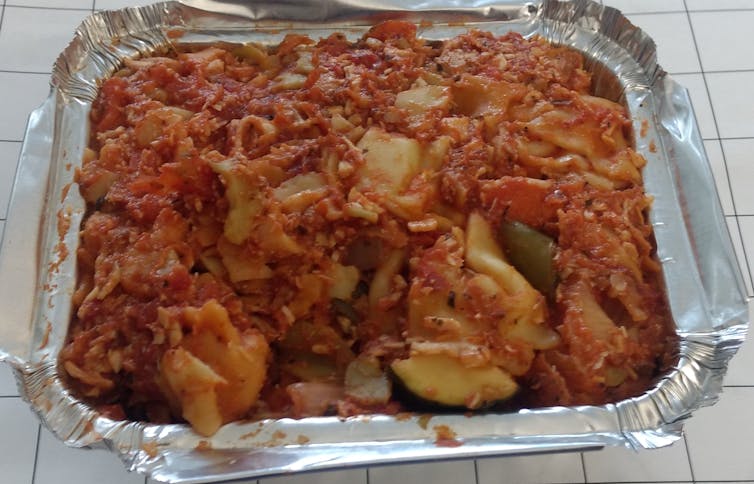
Catered lunches concerned extra scratch cooking and fewer prepackaged meals than the previous in-house program, however some college students seen it as much less do-it-yourself.
(Sinikka Elliott), Creator supplied
Restricted affect over catering
The brand new program was meant to broaden the attain of college meals to extra college students, but fewer youngsters opted into this system throughout its first few months. Each the brand new and previous applications have been voluntary, and college students in want may obtain decreased worth or free lunches.
We spoke to highschool employees after the catered program was applied. With the change, they discovered there have been hoops to leap by way of to make changes they usually nervous this affected college students’ entry. From frozen accounts on account of nonpayment, to college students getting the flawed meal with no choice to whip up a substitute, college employees felt they might not correctly care for college students.
Employees expressed misery at not having the ability to assist their college students. As one employees member informed us, “We simply wish to assist folks. We simply wish to feed the children.”
As a result of this system was operated by the catering firm, college employees had restricted affect over it in comparison with the previous program. The adjustments made it arduous for them to fulfill their college students’ primary wants.
Care on the menu
Designing efficient meal applications to make sure no baby misses out means acknowledging that feeding youngsters requires nurturing, caring relationships. Faculty lunch staff aren’t the one ones who can do that work, however our analysis means that they’ll serve on the coronary heart of vibrant care infrastructures in faculties that anticipate, establish and meet youngsters’s various wants for meals and connection.
However this requires giving them the time and autonomy to craft and run applications that work finest for his or her college students. Sadly, college lunch staff — like care staff typically — are sometimes overworked, poorly paid and undervalued.
As youngsters acclimatize to being again to highschool after months of social isolation, mother and father, faculties and coverage makers must work collectively in the direction of coverage actions to reduce the impacts of the various stressors that youngsters confronted throughout college closures and because the pandemic continues.
In the USA, well being coverage specialists think about federally run college meals applications to be a key aspect of the nation’s COVID-19 response and technique to help youngsters by way of the pandemic.
UNICEF additionally recommends prioritizing baby diet and feeding applications as a core technique for supporting college youngsters globally, no matter whether or not faculties stay open or are closed on account of COVID-19.
Learn extra:
Federal price range pledges a Canadian college meals program however recipe requires funding
Canada now has a useful alternative to acknowledge college meals applications as a part of the nationwide COVID-19 technique. The recipe for efficiently supporting youngsters by way of this pandemic and past mustn’t overlook the particular ingredient of care in class lunches.

Sinikka Elliott receives funding from the Social Sciences and Humanities Analysis Council of Canada, the Canadian Institutes of Well being Analysis, the Russell Sage Basis, and the Vancouver Basis.
Jennifer Black receives funding from the Canadian Institutes of Well being Analysis and the Social Sciences and Humanities Analysis Council of Canada. She is affiliated with the Peter Wall Institute for Superior Research on the College of British Columbia the place she is a 2020-2021 Wall Scholar.
via Growth News https://growthnews.in/care-is-the-secret-ingredient-in-school-lunch-programs/